
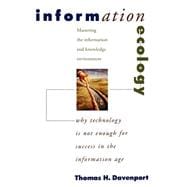
Information Ecology Mastering the Information and Knowledge Environment
by Davenport, Thomas H.; Prusak, LauranceFormat: Hardcover
Pub. Date: 1997-06-26
Publisher(s): Oxford University Press
 Other versions by this Author
-
 eCampus.com Device Compatibility Matrix
Click the device icon to install or view instructions
 Apple iOS | iPad, iPhone, iPod
 Android Devices | Android Tables & Phones OS 2.2 or higher | *Kindle Fire
 Windows 10 / 8 / 7 / Vista / XP
 Mac OS X | **iMac / MacbookEnjoy offline reading with these devicesiPad, iPhone, iPod
 Android 2.2 +Kindle FireWindows
10 / 8 / 7 / Vista / XPMac


List Price: $88.53
Buy New
Usually Ships in 8 - 10 Business Days.
$88.44
Buy Used
Usually Ships in 24-48 Hours
$66.40
Rent Textbook
Select for Price
Digital
$58.79*
How Marketplace Works:
- This item is offered by an independent seller and not shipped from our warehouse
- Item details like edition and cover design may differ from our description; see seller's comments before ordering.
- Sellers much confirm and ship within two business days; otherwise, the order will be cancelled and refunded.
- Marketplace purchases cannot be returned to eCampus.com. Contact the seller directly for inquiries; if no response within two days, contact customer service.
- Additional shipping costs apply to Marketplace purchases. Review shipping costs at checkout.
Summary
According to virtually every business writer, we are in the midst of a new "information age," one that will revolutionize how workers work, how companies compete, perhaps even how thinkers think. And it is certainly true that Information Technology has become a giant industry. In America, more that 50% of all capital spending goes into IT, accounting for more than a third of the growth of the entire American economy in the last four years. Over the last decade, IT spending in the U.S. is estimated at 3 trillion dollars. And yet, by almost all accounts, IT hasn't worked all that well. Why is it that so many of the companies that have invested in these costly new technologies never saw the returns they had hoped for? And why do workers, even CEOs, find it so hard to adjust to new IT systems? In Information Ecology , Thomas Davenport proposes a revolutionary new way to look at information management, one that takes into account the total information environment within an organization. Arguing that the information that comes from computer systems may be considerably less valuable to managers than information that flows in from a variety of other sources, the author describes an approach that encompasses the company's entire information environment, the management of which he calls information ecology. Only when organizations are able to combine and integrate these diverse sources of information, and to take them to a higher level where information becomes knowledge, will they realize the full power of their information ecology. Thus, the author puts people, not technology, at the center of the information world. Information and knowledge are human creations, he points out, and we will never excel at managing them until we give people a primary role. Citing examples drawn from his own extensive research and consulting including such major firms as A.T. & T., American Express, Ford, General Electric, Hallmark, Hoffman La Roche, IBM, Polaroid, Pacific Bell, and Toshiba Davenport illuminates the critical components of information ecology, and at every step along the way, he provides a quick assessment survey for managers to see how their organization measures up. He discusses the importance of developing an overall strategy for information use; explores the infighting, jealousy over resources, and political battles that can frustrate information sharing; underscores the importance of looking at how people really use information (how they search for it, modify it, share it, hoard it, and even ignore it) and the kinds of information they want; describes the ideal information staff, who not only store and retrive information, but also prune, provide context, enhance style, and choose the right presentation medium (in an age of work overload, vital information must be presented compellingly so the appropriate people recognize and use it); examines how information management should be done on a day to day basis; and presents several alternatives to the machine engineering approach to structuring and modeling information. Davenport makes explicit what many managers already know in their gut: that useful information flow depends on people, not equipment. In Information Ecology he paves the way for all managers to build a more competitive, creative, practical information environment for their companies.
Author Biography
Thomas H. Davenport, author of the best-selling Process Innovation: Reenigineering Work Through Information Technology, combines real-world business experience with an academic's understanding of the principles that underlie effective business management. He is presently the Curtis Mathes Fellowship Professor, and Director of the Information Management Program at the University of Texas, Austin. A former partner and Director of Research at the consulting firm of Ernst & Young, Davenport has consulted for McKensey and Co., CSC Index, and remains a Research fellow at Enrsnt & Young's Center for Business Innovation. He has written for the Harvard Business Review, Sloan management Review, and writes a monthly column for CIO Magazine. Larry Prusak is Practice Leader in Knowledge Management for IBM Consulting Group.
Table of Contents
| Preface and Acknowlegments | ix | ||||
|
3 | (12) | |||
|
15 | (13) | |||
|
28 | (18) | |||
|
46 | (21) | |||
|
67 | (16) | |||
|
83 | (25) | |||
|
108 | (26) | |||
|
134 | (22) | |||
|
156 | (19) | |||
|
175 | (18) | |||
|
193 | (25) | |||
|
218 | (11) | |||
| Notes | 229 | (18) | |||
| Index | 247 |
An electronic version of this book is available through VitalSource.
This book is viewable on PC, Mac, iPhone, iPad, iPod Touch, and most smartphones.
By purchasing, you will be able to view this book online, as well as download it, for the chosen number of days.
Digital License
You are licensing a digital product for a set duration. Durations are set forth in the product description, with "Lifetime" typically meaning five (5) years of online access and permanent download to a supported device. All licenses are non-transferable.
More details can be found here.
A downloadable version of this book is available through the eCampus Reader or compatible Adobe readers.
Applications are available on iOS, Android, PC, Mac, and Windows Mobile platforms.
Please view the compatibility matrix prior to purchase.